
Introduction
"You have worked on your research for months—perhaps even years—and at last, you press the 'submit' button, hoping to see your work in print soon. However, the wait starts right then. What goes on behind the scenes? Who will read your research? Why does it take so long, and what if your work gets rejected?"
"Peer review does not aim at preventing good research from getting published—its purpose is to improve good research further."
Publishing a research paper is certainly thrilling, although at the same time it can also be very daunting. One of the greatest uncertainties that come to authors once they have submitted their manuscripts is the process that follows after this point. This uncertainty usually starts with a flood of questions such as Has the editor seen my paper? Who will review it? How long will it take? What if the reviewers don't like my work?
If you have ever found yourself asking these questions, you are not alone.
Millions of manuscripts are sent to various journals annually in all disciplines. Prior to being included in the scientific record, most of these have gone through an assessment called the Peer Review Process. This enables journals to guarantee that the researches published are accurate, ethical, and useful to the scholarly world.
Even if the peer review process might appear to be a nuisance sometimes, it is inevitable if there has to be better research papers. Generally speaking, feedback from the reviewer helps the writer polish his research paper, making it more accurate, reliable, and informative.
In this guide, you will learn the entire process, beginning with submission of the manuscript up until the final editorial decision. This guide also highlights the peer review process, its significance, the different models of peer review used by various journals, issues faced by authors during this process, and how AI has affected the entire scholarly publishing process.
Let's begin with the most basic question.
What Is Peer Review?
You have finally finished your research, writing, and revising process and submitted your paper for publication in a particular journal. But do you really expect to see your paper in print immediately?
Rather, your work undergoes an evaluative process, whereby the manuscript is examined by experts from your field of study before publication. This process is known as peer review.
So basically, What is peer review in simple terms?
Then one can say that it is a quality check process followed by academic journals to examine if the manuscript is suitable for publishing. Your work is examined by independent experts who could be researchers and professors having knowledge about the field in which you have conducted your research.
Understanding how does peer review work in practice can help you to know what reviewers are actually looking for.
They actually don't just look for mistakes. They ask important questions like:
- Is the research question significant?
- Is the methodology suitable?
- Are the results based on the data?
- Have the ethical considerations been met?
- Does this study contribute new innovation to the field?
Reviewers will offer constructive comments based on their assessment and recommend whether the manuscript should be accepted, revised, or rejected.
In this context, the peer review process can be described as having your research work scrutinized by fellow researchers prior to being released to the wider audience. The purpose of the reviewers is not to tear down your study but rather to improve it.
Why Is Peer Review Important in Academic Publishing?
Just imagine what would happen if any individual was allowed to post their scientific research without any review whatsoever.
It wouldn't be difficult for false data, flawed conclusions, and bad experiments to make their way into the scholarly record. Other researchers might conduct further research on those baseless findings, wasting their time, money, and energy in the process.
That is precisely why peer reviewed articles is needed. This is also the reason why peer-reviewed literature is usually more credible than non-peer-reviewed material.
Review process is a vital quality control mechanism for the research prior to its release to the reader. It is through requesting experts to evaluate the manuscript that journals are able to guarantee the publication of high-quality research.
Peer review is important because it helps:
- Increase the quality of research prior to publication.
- Detect mistakes that authors might have missed.
- Ensure that scholarly publications adhere to ethical standards.
- Build credibility in published results.
- Foster constructive criticism of manuscripts.
Although no process can be entirely perfect, peer review has been the bedrock of scholarly publication for years because it instills principles such as transparency, accountability, and constant improvement.
For the researcher, publishing through peer reviewed journals is considered more credible as well. Universities and other institutions may consider studies published through such an evaluative process more valuable.
Benefits of Peer Review in Academic Publishing
Initially, such comments from reviewers might look very frightening. Receiving a letter loaded with comments, suggestions, and recommendations could be very demotivating.
However, there are a lot of experienced researchers who could confirm that some of their best papers were improved greatly thanks to these comments.
That's because peer review benefits everyone involved.
For Authors
Experts give authors feedback to help them see their weaknesses, areas for improvement, and even those places where further clarification is needed.
Even if there is a lot of rewriting, it usually results in a better manuscript.
Some key benefits include:
- Organization and clarity are better.
- Scientific accuracy is improved.
- Arguments have more evidence to back them up.
- Higher probability of being published.
- Credibility will increase once it is published.
For Journals
Academic journals employ peer review to ensure high publishing standards.
The review process ensures that the editors publish accurate and credible research without damaging the reputation of the journal.
It also helps journals:
- Maintain scientific integrity.
- Improve publication quality.
- Build trust among readers.
- Reduce the risk of publishing flawed research.
For Reviewers
Although reviewers usually work voluntarily, they also benefit from participating in the process.
Reviewing manuscripts allows them to:
- Stay updated with the latest research.
- Develop critical evaluation skills.
- Contribute to the advancement of their discipline.
- Strengthen their academic profile.
For Readers
While the readers may not access the reviews, they always gain from the whole procedure when they read any article that is published.
Since the manuscripts have undergone the evaluation process through the subject experts, then the readers can be assured that the peer reviewed research they are accessing is valid and reliable.
In other words, peer review contributes to making a better scientific community.
The People Behind the Peer Review Process
People always assume that only two parties are involved in the peer review process; however, many people participate in order to ensure that academic peer review becomes both objective and professional.
So, let us find out who participates in the academic peer review process.
1. The Author
All starts from the author.
After finishing the research, the author writes his manuscript following the rules set by the journal and submitting it to be reviewed.
However, this is not where the author's job ends.
During the review process, authors can have to answer reviewers' questions, edit different parts of the manuscript, conduct more analysis, etc.
The publication is often determined by how accurately authors respond to reviewers' comments.
2. The Editor
The editor serves as the guide throughout the entire publication process.
Prior to submitting manuscripts to any reviewers, an initial review is conducted by the editor to find out if the manuscript meets the aims and scopes of the journal and also abides by submission requirements.
In case that the manuscript meets all these criteria, the editor chooses qualified reviewers with knowledge on the same field.
Following the feedback from the reviewers, the editor makes a final decision.
3. The Peer Reviewers
Peer reviewers are independent scientists who assess the scientific merits of the manuscript.
Instead of just checking for grammatical errors, they look at crucial factors like:
- Originality of the research
- Study design
- Research methodology
- Data analysis
- Ethical compliance
- Conclusions
- References
The input provided by them helps the authors and editors to decide whether the paper can be published or not.
4. The Editorial Office
Although editors and reviewers are occupied with assessing research, it is the editorial office that handles the publishing process. Through their efforts, all stages of the peer review process run smoothly despite the volume of submissions.
They facilitate communication, check deadlines, help the authors while submitting articles, and make sure that the reviewing process is as smooth as possible.
Authors do not normally come into contact with all members of the editorial team; however, their contribution is vital for organizing the process of publication.
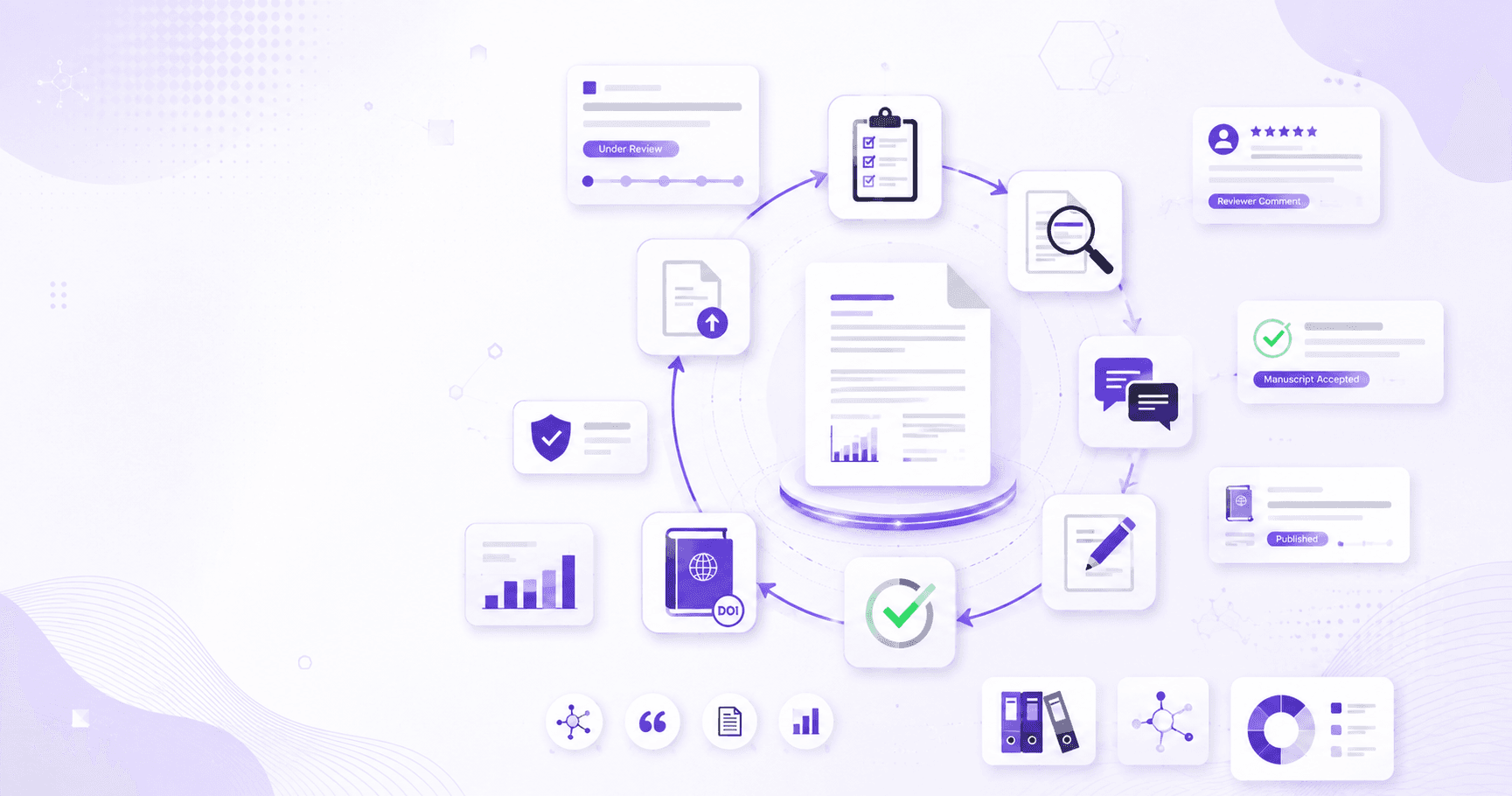
From Submission to Final Decision: Understanding the Peer Review Journey
Having learned about the people behind manuscript peer review, let us trace the process of manuscript submission to the journal’s final decision.
Many first-time authors believe that after clicking the Submit button, their work is done. In fact, this is just the beginning.
In the background, editors, reviewers, and the editorial team join hands to critically review each submission. The time taken will vary according to different journals from a few weeks to several months.
Here is how it goes.
Step 1: Manuscript Submission
It all begins with uploading your manuscript via the journal’s submission system online.
Besides your manuscript, there is often a requirement for other documents, including but not limited to:
- Cover letter
- Author information
- Declaration of conflict of interest
- Ethical approval
- Supporting files
Take a last-minute glance before you click submit because any mistake can set back your manuscript before it even gets reviewed.
Step 2: Editorial Screening
However, once the manuscript is submitted to the journal, it does not go straight into review.
First, the editor screens the manuscript to address several important questions.
- Does the manuscript fit the journal's scope?
- Is the research original?
- Are the formatting guidelines followed?
- Are ethical requirements fulfilled?
- Is the writing clear enough for reviewers to evaluate?
At this point, some papers can be rejected even before sending them for review. This does not necessarily imply that the research was weak, but rather, it could be irrelevant to the interests of the journal.
If all is well, the paper proceeds to the next level.
Step 3: Reviewer Selection
Now the editor starts looking for people who specialize in your field of study.
This process may sometimes be slower than what the authors expect because identifying suitable reviewers is not always an easy task. Editors try to find someone with relevant expertise, enough time to review the manuscript, and no conflicts of interest.
The majority of journals usually ask two or three people to review the manuscript.
Step 4: Manuscript Evaluation
This is when the actual evaluation begins.
The reviewers do not just read your paper; instead, they scrutinize every part of the paper to see if it deserves publication.
They typically evaluate:
- The originality of your research
- The importance of your research question
- Study design and methodology
- Data analysis and interpretation
- Accuracy of results
- Ethical compliance
- References and supporting literature
- Overall clarity of writing
At the conclusion of the review process, each reviewer will provide the editor with recommendations and detailed comments.
Step 5: Editorial Decision
After reviewing all reports, the editor makes a decision.
In most cases, one of these outcomes is communicated to the author.
| Editorial Decision | What It Means |
|---|---|
| Accept | The manuscript is ready for publication with little or no further changes. |
| Minor Revision | Small improvements are needed before acceptance. |
| Major Revision | Significant revisions are required, but the manuscript still has publication potential. |
| Reject | The manuscript does not meet the journal's requirements for publication. |
Don't be discouraged if you receive a revision request.
In actuality, only a few of the submitted papers will get approved as they are. The receipt of feedback from reviewers is common in the process of publication.
Step 6: Revision and Resubmission
Here you have your chance to polish up the manuscript.
Instead of reacting emotionally to the comments given by the reviewer, study the comments attentively and then answer them one after another.
It is normal for most of the journals to expect from the author to provide:
- The revised manuscript
- The response letter
- Explanation of all changes
Even if you do not agree with a particular reviewer, explain why professionally and provide evidence.
Step 7: Final Acceptance and Publication
Once the editor is convinced that all the concerns raised by the reviewers have been resolved, the article is accepted.
Then the article enters the production stage, where it will undergo the following:
- Copyediting
- Proofreading
- Typesetting
- Final author approval
- Online publication
Congratulations—you've successfully reached your goal!
How Long Does Peer Review Take?
One of the first questions that writers tend to pose after they submit their paper is:
"When can I expect a response from the journal?"
This question cannot be answered easily.
While some journals can finish the review procedure in a couple of weeks, other journals might need a couple of months for completing the process.
Here's a general timeline that many journals follow.
| Stage | Typical Time |
|---|---|
| Editorial Screening | 3–7 days |
| Reviewer Invitation | 1–2 weeks |
| Peer Review | 2–6 weeks |
| Author Revisions | 2–8 weeks |
| Final Decision | 1–2 weeks |
Remember that this is an estimation on an average level. Some papers go through the process fast enough, while others may need more than one round of revisions.
Why Can Peer Review Take So Long?
Being left waiting can be a tedious experience, but there are sometimes legitimate reasons for it.
The most frequent reasons are:
- Difficulties in finding suitable reviewers
- Reviewers requesting additional time
- Several rounds of revisions
- Overload of submissions
- Complex or very specific research
If you find that your manuscript is delayed, this does not have to indicate any problem with it.
Types of Peer Review
Each journal follows a unique process when reviewing papers.
The review process has evolved over time to ensure greater fairness, minimize bias, and enhance transparency.
Below are the various forms of peer review that exist.
| Review Type | How It Works | Best For |
|---|---|---|
| Single-Blind Peer Review | Reviewers know the author's identity, but authors do not know the reviewers. | Traditional academic journals |
| Double-Blind Peer Review | Both authors and reviewers remain anonymous throughout the review process. | Most scholarly journals seeking to reduce bias |
| Triple-Blind Peer Review | Authors, reviewers, and editors have limited identity information during evaluation. | Journals aiming for maximum impartiality |
| Open Peer Review | Reviewer identities and, in some cases, review reports are made public. | Journals promoting transparency |
| Post-Publication Review | Research continues to receive comments and evaluation after publication. | Open science platforms |
No single model can be called the "best" review system.
The choice depends on which strategy helps achieve the desired results for the publication.
Common Challenges Authors Face During Peer Review
Everyone undergoes uncertainties during the peer review process—even experienced researchers.
Let us consider some of the most common problems faced by writers.
1. Long Waiting Times
Waiting for reviewer comments can be very stressful.
Rather than checking your email every hour, you should use the waiting time productively by preparing your next paper or working on ongoing research.
2. Conflicting Reviewer Comments
In some cases, there is an instance where one of the reviewers may recommend acceptance of your work but another recommends revisions.
While it might seem confusing, the editors take all this into consideration when making an informed decision.
What matters is to respond to all suggestions in a respectful way.
3. Major Revision Requests
A long list of revisions may be quite daunting.
Keep in mind that significant revisions do not necessarily mean that you have failed.
More often than not, it means that the journal sees great promise in your work and wants to help polish it up.
4. Manuscript Rejection
Rejection is an inevitable part of any research career.
Even renowned scientists get their papers rejected.
Do not take rejection as failure but rather improve your manuscript based on the suggestions of reviewers and resubmit it to another journal.
5. Common Reasons Manuscripts Get Rejected
Actually, many manuscripts could have been avoided from being rejected.
Below are some of the reasons why manuscripts get rejected by editors.
- The article is out of scope for the journal.
- There is no originality in the research findings.
- The research methodology is poor or poorly described.
- The results do not support the conclusions.
- There is a lack of important references.
- There are language problems in the manuscript.
- There is an ethical concern.
- The paper does not describe its contribution to knowledge.
Taking the time to properly prepare your manuscript before submission will greatly increase your chances of success.
AI-Assisted Peer Review: The Future of Academic Publishing
AI technology is transforming every single aspect of the research process, including peer review.
Many journals use AI-assisted peer review systems to aid the editors in evaluating the manuscripts in their initial stages.
These can be used to:
- Detect plagiarism.
- Detecting duplicate submissions.
- Detects problems in references and reporting.
- Suggest appropriate reviewers.
- Filter out manuscripts with formatting issues.
AI, however, is not a replacement for human reviewers.
It can detect patterns or flag issues, but it cannot determine scientific creativity, significance of the research, ethics, or the implications of the study in the real world.
In the future of academic publishing, there is a possibility of merging the swiftness of AI technology with the professional acumen of the researcher himself.
With responsible use, AI technology can revolutionize peer review by increasing efficiency and consistency in the process while ensuring that human judgment is integral to every process of the editor.
Best Practices for Authors Before and After Peer Review
By the time your manuscript gets to the peer review process, much of the difficult task will have been accomplished. However, what you do in preparation for the submission, and what you do after the submission, makes a lot of difference.
Do not see the peer review process as a battle, but rather as a discussion. Do not strive to "beat" the reviewers, but rather work together to develop the best possible variant of your research.
Before You Submit Your Manuscript
Just a little bit of additional effort can help avoid weeks of delays later on.
Here are some things you should be asking yourself before you submit:
- Is my research relevant to the journal's scope?
- Have I adhered to the guidelines of the journal?
- Are figures, tables, and references included in the manuscript?
- Have I proofread the manuscript for grammatical and other mistakes?
- Have I included all the required ethics information?
- Do all the co-authors approve the manuscript?
And, of course, it is always a good idea to have your manuscript reviewed by a colleague or mentor prior to submission.
While Your Manuscript Is Under Review
After the submission of your manuscript, there isn't much you can do but wait and this is very normal.
Rather than thinking about the result, use this period to engage yourself in something productive. You can either work on your next project or work on presentations for your work.
Note that long review periods don't necessarily signify a problem. Editors require time to find appropriate reviewers, and reviewers have to manage their time to handle these tasks along with their own academic pursuits.
After Receiving Reviewer Comments
Opening the decision email is always intimidating, particularly when you see many pages full of reviewer comments.
Take a deep breath and go through all the comments before replying.
Many comments may seem negative in the beginning, but most reviewers only wish to help you improve your manuscript.
When preparing your revisions:
- Respond to each individual comment raised by all reviewers.
- Maintain a professional tone throughout, even when disagreeing.
- Clarify any changes that have been made.
- Provide supporting evidence where appropriate in your response.
- Thank the reviewers for their time and constructive feedback.
A respectful and well-organized response letter often makes the revision process much smoother.
Peer Review Checklist for Authors
Before submitting your paper, try this handy checklist to ensure you are ready to go!
✓ Before Submission
- Choose a journal compatible with your research.
- Understood and followed author instructions.
- Ensured there are no grammatical errors.
- Crosschecked all references and citations.
- Got all the needed ethics approvals.
- Ensured that all the authors agreed to the submission.
- Checked figures, tables, and supplementary materials.
- Drafted an informative cover letter.
✓ After Receiving Reviewer Comments
- Read every comment carefully.
- Avoided responding emotionally.
- Revised the manuscript thoroughly.
- Prepared a detailed response letter.
- Explained every change clearly.
- Submitted the revised manuscript before the deadline.
However, following these simple guidelines will not necessarily mean that your application will be approved; however, it will definitely increase its chances of quality and professionalism.
Frequently Asked Questions
Is peer review always anonymous?
Not necessarily. It will depend on the editorial policy of the journal. There are journals that implement single-blinding or double-blinding peer-review process, and there are journals that apply open or triple-blinding peer-review system.
Can a manuscript be accepted without revisions?
Yes, but this is rare. Most manuscripts get recommendations from reviewers, even if the recommendation is small. Revision recommendations are common in the process of scholarly publication and improve the manuscript.
What should I do if I disagree with a reviewer's comments?
It is perfectly fine to disagree as long as you do so in a respectful manner. Make sure that you explain yourself well and back up your answers with evidence.
Can AI replace human reviewers?
No, artificial intelligence may assist editors in checking the manuscript for plagiarized material, formatting and other standards, however, it will not be able to assess scientific originality and significance of the research.
Does a rejected manuscript mean my research is poor?
Absolutely not. There could be many reasons for the rejection of manuscripts, such as journal’s scope, lack of novelty, or simply editor’s preference. Successful research papers were often rejected before they got published somewhere else after revision.
Final Thoughts
Every researcher dreams of getting their work published, but getting published is no easy task. There is always a learning curve and a lot of improvement behind any published paper.
The Peer Review Process might appear intimidating at the very beginning, particularly when you send your first manuscript. Indeed, waiting for the outcome, answering reviewers' questions, and doing revisions will require much patience from you. However, every single step that you take during this process has one goal – improving science.
While you see peer review as something that stands between you and success, you should see it as a chance to improve your work by having your ideas scrutinized by fellow researchers devoted to knowledge.
No draft is flawless upon the first submission. Even experienced writers get criticized and required to revise their work. Sometimes, what distinguishes successful scientists from others is not the absence of criticism, but how they handle it.
Even as the world of scholarly publishing advances into the year 2026, using technology and artificial intelligence in editorial processes, there is one constant – high-caliber research is built upon careful review, publishing ethics, and collaboration within the academic community.
No matter whether you are preparing your first ever manuscript or your fiftieth one, knowing about the entire peer review process will make sure that you are better prepared for the process of publishing your paper and a stronger chance of success.
Remember, every reviewer comment is an opportunity to improve your research, and every revision brings your manuscript one step closer to publication.